
Pakistani security forces killed 23 terrorists in Khyber Pakhtunkhwa province during operations on Wednesday and Thursday, according to the military's media wing.

Myanmar President U Min Aung Hlaing assured Prime Minister Narendra Modi that Myanmarese territory would not be allowed to be used against India's security interests, as the two leaders held wide-ranging talks to boost bilateral ties in trade, defence, and energy.

Lieutenant General Seth's involvement in the army's capability development and modernisation efforts is evident from the key appointments he has held in the Strategic Planning and Capability Development Directorates, including Colonel Capability Development for Mechanised Forces, Brigadier Perspective Plans and Acquisition, and Additional Director General Capability Development.
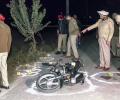
Punjab Police have busted two ISI-backed espionage modules using high-tech, China-made solar powered CCTV cameras to transmit live feeds of sensitive military locations to Pakistan-based handlers.

Media reports based on intelligence sources say nearly half of Iran's missile launchers remain intact, while thousands of one-way attack drones are still part of its arsenal even after continuous strikes targeting military infrastructure over the past five weeks.

The US has seized an oil tanker, 'Skywave', linked to Iran in the Indian Ocean, as part of efforts to disrupt Iran's oil shipments and enforce sanctions. The vessel was part of a network transporting sanctioned Iranian crude oil, with the seizure occurring amid heightened tensions between Washington and Tehran.

US President Donald Trump has claimed that Iran's missile capabilities have been severely degraded, saying Tehran now possesses only a fraction of the arsenal it had before recent hostilities.

The Iranian military on Thursday issued a strongly worded response to remarks made by United States President Donald Trump, warning that the ongoing conflict will persist until Washington, DC faces what it described as 'permanent humiliation, regret, and surrender', as reported by Iranian state media Press TV.

Iranian authorities have announced the arrest of 35 individuals on charges ranging from espionage to illegal trafficking, including alleged Mossad-linked suspects and affiliates of separatist organisations.

In a development that could reshape West Asia's security landscape, US President Donald Trump announced Friday that he will convene an emergency meeting in the White House Situation Room to make a final decision on a broad, multi-part peace deal with Iran.

India has strongly protested to the United States after three merchant ships with Indian crew members were attacked by the American military off the coast of Oman, resulting in the deaths of three Indian nationals.

Chief of Army Staff General Upendra Dwivedi stated that the armed forces are fully prepared for 'Operation Sindoor 2.0' if the need arises, emphasising enhanced synergy across all three services for modern multi-domain warfare.

The Beijing summit may have reduced immediate diplomatic uncertainty, but it did not resolve the deeper structural contest between the United States and China. That contest appears likely to define the coming decade, notes Varun Arya.
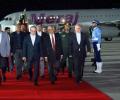
A new report alleges Pakistan shielded Iranian military aircraft from potential US airstrikes, raising questions about its role as a neutral mediator in the ongoing US-Iran tensions.

The Israeli Air Force (IAF) said it struck several targets in Tehran, Shiraz and Ahvaz simultaneously over the past 24 hours, targeting sites linked to Iran's ballistic missile programme, air defence systems and military headquarters.
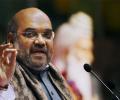
Union Home Minister Amit Shah hailed Operation Sindoor as a landmark mission, commemorating its first anniversary and underscoring India's military strength and resolve against cross-border terrorism.

The Indian military will showcase an Operation Sindoor-themed tableau for the Republic Day parade, highlighting the jointness of the three services and India's military capabilities.

The United States used an array of weapons in the strikes conducted against Iran as part of Operation Epic Fury on Saturday -- which included artificial intelligence services from Anthropic, according to a report by Reuters.
Pakistani security forces killed 27 terrorists belonging to the banned Tehreek-e-Taliban Pakistan (TTP) in multiple operations over the weekend in the country's northwest, officials said on Sunday.

Delhi Police's Special Cell has dismantled an inter-state terror, arms, and espionage module allegedly supported by Pakistani handlers and the ISI, revealing a covert surveillance network near sensitive military locations.
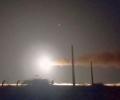
US President Donald Trump maintains that the ceasefire with Iran is still in effect despite recent military engagements near the Strait of Hormuz. He also commented on a recent clash where US forces responded to Iranian attacks on US Navy destroyers.
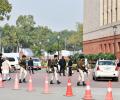
Bangladesh Police have issued a nationwide security alert following intelligence reports of potential militant attacks on key installations, including the parliament complex and places of worship.
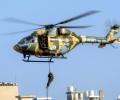
'The tools of warfare are changing. The MoD must deepen its engagement with technology thinkers that can present compelling visions of where warfare may be heading.'
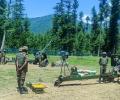
'India's security challenges are no longer confined to the Line of Control or the Line of Actual Control.'
'They also span cyber networks, economic systems, information warfare, technology ecosystems, maritime routes, and internal social cohesion.'
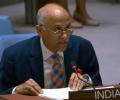
India has strongly criticised Pakistan at the UN Security Council, highlighting civilian deaths and injuries in Afghanistan caused by cross-border violence by Pakistani military forces, accusing Pakistan of 'heinous acts' and 'systematic genocide'.
The Congress party has criticised the Modi government on the first anniversary of the Pahalgam terror attack, stating that Pakistan has gained global respectability due to the failure of Prime Minister Narendra Modi's foreign policy.

'The entire US ecosystem built over decades at the bases in the Gulf region, especially the UAE, costing trillions of dollars have been decimated, dealing a mortal blow to the US Central Command's war capability,' points out Ambassador M K Bhadrakumar.

China has denied any links to the Iranian cargo ship seized by the US in the Gulf, which allegedly contained chemical materials for manufacturing missiles. The denial follows allegations by former US envoy to the UN Nikki Haley, who claimed the ship was headed from China to Iran.
'We won not (only) because we were able to carry out long-range precision strikes.' 'That is, of course, one of the reasons but we had better situational awareness about what's happening than Pakistan.'

Experts' worries intensified after Pakistan commissioned its first Chinese-built Hangor-class submarine, PNS Hangor, last month.

Israel initiated military action against Iran shortly after Prime Minister Narendra Modi's visit, capitalising on a fleeting opportunity and years of strategic preparation, according to Israel's ambassador to India.

The Union government has informed the Bombay High Court that Agniveers are not "similarly situated" as regular soldiers and hence, cannot claim parity in pensionary benefits for their next of kin in the event of death in action.
For India, China's Indian Ocean power projection, maritime domain awareness, dual-use ports, underwater surveillance, antisubmarinewarfare, naval exercises with Pakistan, pose considerable pressure, depleted India's strategic depth and marginalises Indian role, points out Srikanth Kondapalli.

The Maharashtra Anti-Terrorism Squad (ATS) conducted raids at over 40 locations across the state, including Mumbai, targeting individuals connected to Pakistan-based gangster Shahzad Bhatti, who is accused of influencing Indian youth towards anti-national activities through social media.

US President Donald Trump is set to visit China for talks with President Xi Jinping on trade, global issues, and the Gulf war. The visit aims to address trade frictions and other key issues, with high expectations for progress.

The IRGC also warned residents to evacuate areas near military bases, security centres and government facilities.

The OnePlus Nord CE6 features a 6.78-inch 1.5K AMOLED display with a 144 Hz refresh rate, a Snapdragon 7s Gen 4 chipset, a 50MP main camera, and an 8,000 mAh battery with 80W SUPERVOOC charging.

Prayagraj native Sumit Kumar is suspected to have passed on sensitive information related to air force operations, including details of fighter aircraft deployment, missile systems and information concerning officers and personnel.

The fragile ceasefire in West Asia between the US and Iran to halt the hostilities in the region for two weeks faces renewed uncertainty as Tehran reportedly moved to block the strategic Strait of Hormuz once again due to Israel's intensified offensive against Hezbollah in Lebanon, according to Iranian state media Islamic Republic News Agency (IRNA), which US President Trump says was "not included" as part of the ceasefire deal.

A Delhi court recently acquitted five accused, including an army personnel and a Border Security Force personnel, in an espionage case. While acquitting the accused persons, the court flagged serious lapses in the investigation.
